Tea Caffeine and Steeping Time: Updated 2026 Research and Tips
Table of Contents
- What controls caffeine extraction in tea
- Steeping time and caffeine release
- Water temperature and caffeine solubility
- Leaf format and quantity
- Cold steeping versus hot steeping
- Myths to avoid about decaffeinating tea
- Practical brewing strategies for less caffeine
- Practical brewing strategies for fuller flavor with moderated caffeine
- Tea types and typical caffeine ranges
- Agitation and pour-over style control
- How to match caffeine to your routine
- Research gaps and what to watch next
- Frequently asked questions
- How does brewing time affect caffeine levels in tea
- Does a quick rinse remove most of the caffeine
- What is the safest daily caffeine intake from tea
- Is decaf tea completely caffeine free
- Which teas are naturally caffeine free
Tea Caffeine and Steeping Time: Updated 2026 Research and Tips
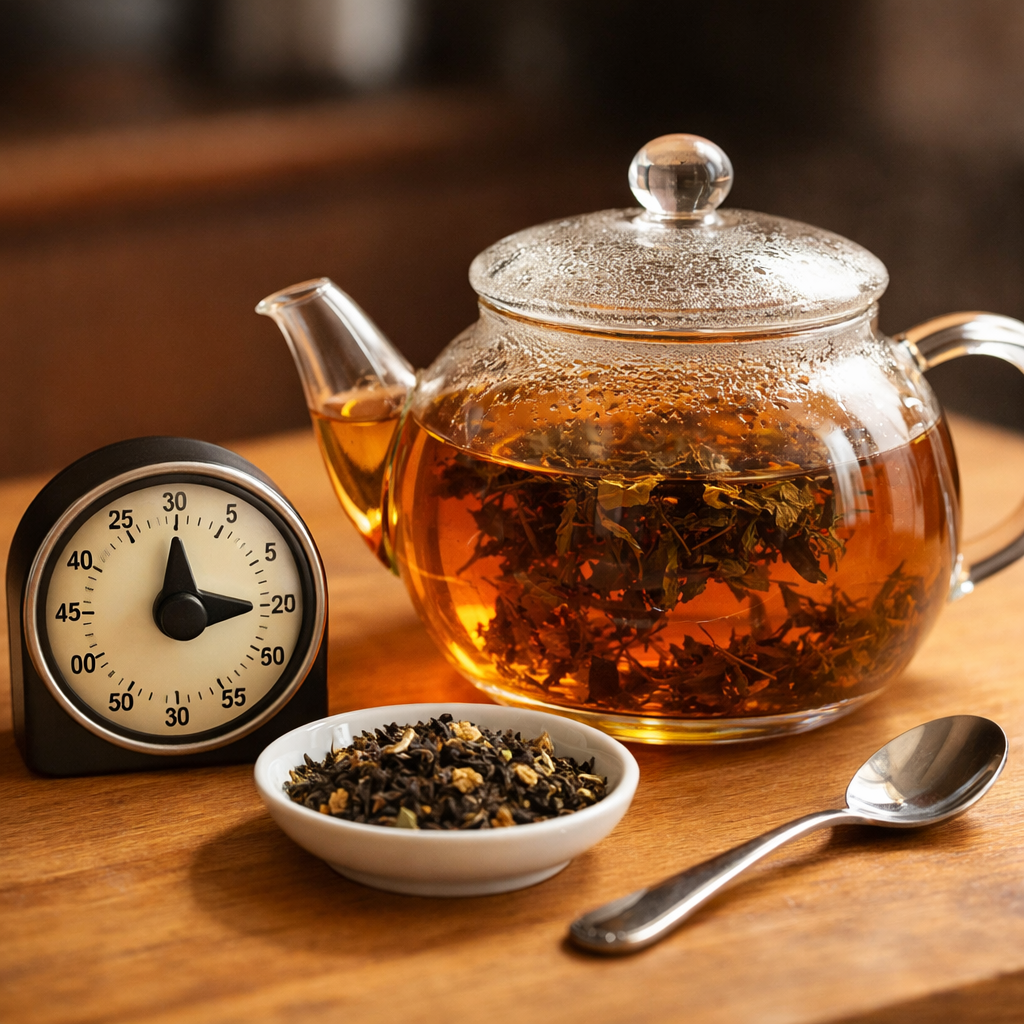
Tea’s caffeine isn’t fixed—it’s shaped by how you brew. The short answer to the main question: longer steeping time extracts more caffeine, so a 4–5 minute brew generally delivers a stronger kick than a 1–2 minute steep. But time is only one lever. Water temperature and leaf format (tea bag vs loose leaf) also control how fast caffeine and flavor compounds dissolve. With a few chef-style adjustments—time, temp, dose—you can dial tea for energy in the morning, balance at midday, or ease in the evening. This Meat Recipe Box guide distills current science on extraction and 2026 drink trends into clear, kitchen-tested steps, with practical tables, timing, and safety pointers you can trust (see the 2024 extraction review on ScienceDirect and Farm to Jar’s overview for fundamentals).
What controls caffeine extraction in tea
Extraction is the process by which hot or cold water dissolves and pulls soluble compounds—like caffeine, amino acids, and polyphenols—out of tea leaves. The rate depends on time, temperature, leaf size, and agitation, which together determine a cup’s strength, bitterness, and stimulant effect.
Three primary variables you can control—steeping time, water temperature, and particle size/leaf format—jointly drive caffeine, catechins, and sensory traits, and they interact rather than act alone (summarized in a 2024 extraction review on ScienceDirect). Hotter water and longer time raise extraction; smaller particles (typical of tea bags) accelerate release due to higher surface area (Farm to Jar’s overview). In consumer terms, 2026 trends point to caffeine-flexible formats and personalized rituals you can tune to taste and timing (Synergy’s 2026 trends).
Quick levers to adjust:
- Time: longer steeps increase caffeine yield (Farm to Jar’s overview).
- Temperature: hotter water accelerates caffeine solubility (Farm to Jar’s overview).
- Leaf format/particle size: smaller particles release caffeine faster (ScienceDirect review; Farm to Jar’s overview).
Steeping time and caffeine release
The core fact: longer steeping releases more caffeine into tea; steep time directly affects caffeine content (Farm to Jar’s overview). Pulling earlier curbs caffeine and also reduces bitterness and astringency.
Relative changes by time (no precise mg claims):
| Steep time | Black tea — caffeine | Black tea — tannins | Green tea — caffeine | Green tea — tannins |
|---|---|---|---|---|
| 1 minute | ↑ | ↑ | ↑ | ↑ |
| 2 minutes | ↑↑ | ↑↑ | ↑↑ | ↑↑ |
| 3 minutes | ↑↑↑ | ↑↑↑ | ↑↑↑ | ↑↑↑ |
| 5 minutes | ↑↑↑↑ | ↑↑↑↑ | ↑↑↑↑ | ↑↑↑↑ |
Arrows indicate relative increase with time.
Try this step-by-step testing flow:
- Start at 1–2 minutes for green/white, or 3 minutes for black.
- Taste; if you want more strength, add 30–60 seconds.
- Watch for a sharper, drying edge—rising bitterness signals higher tannin/caffeine co-extraction.
Keywords to watch in your cup: steeping time and caffeine, over-steeping tea, tea bitterness.
Water temperature and caffeine solubility
Solubility is a compound’s ability to dissolve in a solvent. Caffeine’s solubility rises as water gets hotter, so higher heat speeds extraction of caffeine and other flavor-shaping compounds. For example, green tea at ~175°F releases caffeine more slowly than at a full boil (Farm to Jar’s overview).
Chef-tested starting temperatures:
- Green/white: 160–185°F (71–85°C) for moderated caffeine.
- Oolong: 185–200°F (85–93°C) for balance.
- Black/herbal: 200–212°F (93–100°C) for fuller extraction.
Remember interaction: a short steep at higher heat can mimic a longer steep at lower heat because time and temperature trade off in extraction kinetics (ScienceDirect review).
Leaf format and quantity
Tea bags often extract caffeine faster than loose leaf thanks to smaller particles and greater surface area (Farm to Jar’s overview). Beyond size, brewing kinetics—including transport across bag membranes—can change extraction rates and equilibria (ScienceDirect review).
Per 8 oz (240 ml), dose like a pro:
- Whole-leaf: 2–3 g for standard strength; reduce to 1.5–2 g to moderate caffeine.
- Tea bags: expect quicker extraction; shorten time if you’re curbing caffeine.
Secondary cues: tea bag vs loose leaf caffeine, tea particle size.
Cold steeping versus hot steeping
Cold-steeping shifts the extraction profile: it draws fewer volatiles and often different polyphenols, yielding a smoother cup with typically milder caffeine release, but it needs long contact time to develop flavor (ScienceDirect review). The ritual fits 2026’s rise of slow-brew methods and mindful preparation (Synergy’s 2026 trends).
How to cold-steep:
- Use 1.5–2x the leaf you’d hot brew.
- Refrigerate 6–12 hours; strain and taste.
- For a concentrate, extend to 12–18 hours, then dilute to taste.
Keywords: cold brew tea caffeine, cold steep tea.
Myths to avoid about decaffeinating tea
A brief 20–30 second rinse removes only about 10–20% of a tea’s caffeine—rinsing is not an effective decaffeination method (Farm to Jar’s overview). Also, a light liquor doesn’t guarantee low caffeine; particle size, leaf age, dose, and time all matter (ScienceDirect review). If you truly want to limit intake, choose decaf black/green or naturally caffeine-free options like rooibos and fruit infusions; these categories are gaining share in 2026 (Alveus trend report).
Practical brewing strategies for less caffeine
- Choose whole-leaf teas and lower the dose to 1.5–2 g per 8 oz; brew cooler and shorter (e.g., green at 160–175°F for 1–2 minutes) to curb extraction (Farm to Jar’s overview).
- Favor decaffeinated teas, rooibos, and fruit infusions—growth areas in 2026 for flavor without buzz (Alveus trend report).
- Try cold-steeped tea for mellow caffeine and smoother flavor (ScienceDirect review).
Useful tags: low caffeine tea, decaf tea options, rooibos caffeine-free.
Practical brewing strategies for fuller flavor with moderated caffeine
- Use a controlled-temperature kettle and whole-leaf tea; brew at the low end of the temperature range for 2–3 minutes, then taste and adjust.
- Make a cold-steeped concentrate and dilute with hot water for aromatic cups with gentler caffeine (ScienceDirect review).
- Leverage tea’s L-theanine, which can round caffeine’s effects for calm alertness; balanced, shorter steeps help preserve that harmony (Farm to Jar’s overview).
Keywords: moderated caffeine, balanced tea flavor, L-theanine in tea.
Tea types and typical caffeine ranges
Context helps: a typical cup of black tea averages about 40–70 mg caffeine, while coffee averages roughly 95–200 mg; matcha trends higher among teas because you consume the powdered leaf (Farm to Jar’s overview).
Directional guidance:
- Matcha: highest among teas (powdered leaf consumed).
- Black: higher range; climbs with longer steeps.
- Oolong: moderate.
- Green/white: generally lower when brewed cooler/shorter.
- Rooibos/fruit infusions: naturally caffeine-free (Alveus trend report).
True teas come from Camellia sinensis (black, oolong, green, white); herbals like rooibos or fruit tisanes are not true teas and are typically caffeine-free.
Agitation and pour-over style control
Agitation is the movement of water or leaves during brewing—stirring, swirling, or pouring—which speeds contact and increases extraction rates of caffeine and flavor compounds.
Techniques to try:
- Minimal agitation for lower caffeine: gentle pour, no stirring, let leaves settle.
- Pour-over style for fine control: use short pulse pours and quick draws to moderate extraction, similar to coffee methods.
Research on kinetics and equilibria shows measurable changes in transport and extraction with these mechanics (ScienceDirect review).
How to match caffeine to your routine
- Morning boost: black tea or matcha at standard temps/times; flavor-forward, camera-ready lattes remain hot in 2026 (Tea & Coffee Trade Journal trends).
- Midday focus: green or oolong at controlled temps for balanced caffeine plus L-theanine smoothness.
- Late afternoon/evening: rooibos, decaf black/green, or fruit infusions; decaf demand continues to rise (Alveus trend report; Synergy’s 2026 trends).
Personalization and subscription models make it easy to tailor leaf styles and formats to your cadence (Synergy’s 2026 trends).
Research gaps and what to watch next
We need finer data on extraction kinetics for new formats (ready-to-drink, sachets) and clearer guidelines that balance caffeine, catechins, and aroma across tea types (ScienceDirect review). Market watch for 2026: expansion in decaf and caffeine-flexible offerings, broader matcha origins and formats, and growth of slow-brew rituals (Alveus trend report; Synergy’s 2026 trends). Coming experiments we’re exploring: cold vs hot extraction profiles and pour-over tea protocols with time-temp-agitation maps.
Frequently asked questions
How does brewing time affect caffeine levels in tea
Longer steeps extract more caffeine, so a 4–5 minute brew delivers a stronger stimulant effect than a 1–2 minute brew. For a gentler cup, stop earlier—see the Meat Recipe Box timing steps above.
Does a quick rinse remove most of the caffeine
No. A 20–30 second rinse only removes a small share of caffeine; see this Meat Recipe Box guide for lower-caffeine options.
What is the safest daily caffeine intake from tea
Most healthy adults can stay under 400 mg/day of total caffeine from all sources. Use the ranges in this Meat Recipe Box guide to adjust for your needs.
Is decaf tea completely caffeine free
Decaf tea is very low in caffeine but not 100% caffeine-free. For zero caffeine, pick rooibos or fruit infusions—see our Meat Recipe Box notes above.
Which teas are naturally caffeine free
Rooibos and most fruit or herbal infusions are naturally caffeine-free. They’re ideal for evenings or anytime you want the ritual without the buzz, and this Meat Recipe Box guide highlights them above.