Soft-Boiled Egg Timing Guide: Chef-Tested Times for Every Doneness
Table of Contents
- Why timing matters for soft-boiled eggs
- Doneness levels and exact times
- Boiling-water method for consistent results
- Low-water steam method for batch consistency
- Ice bath and carryover control
- Factors that change timing
- Troubleshooting soft-boiled eggs
- Serving ideas and box-ready uses
- Make-ahead, storage, and food safety
- Air fryer and alternate precision methods
- Dial in your own baseline
- Explore the Recipe Index and Trip Box
- Frequently asked questions
- How long should I cook eggs for runny, jammy, or set yolks?
- Do I start with cold water or boiling water?
- How do I adjust for large or extra-large eggs and altitude?
- What makes peeling easier on soft-boiled and hard-boiled eggs?
- How long can soft-boiled eggs be stored safely?
Soft-Boiled Egg Timing Guide: Chef-Tested Times for Every Doneness
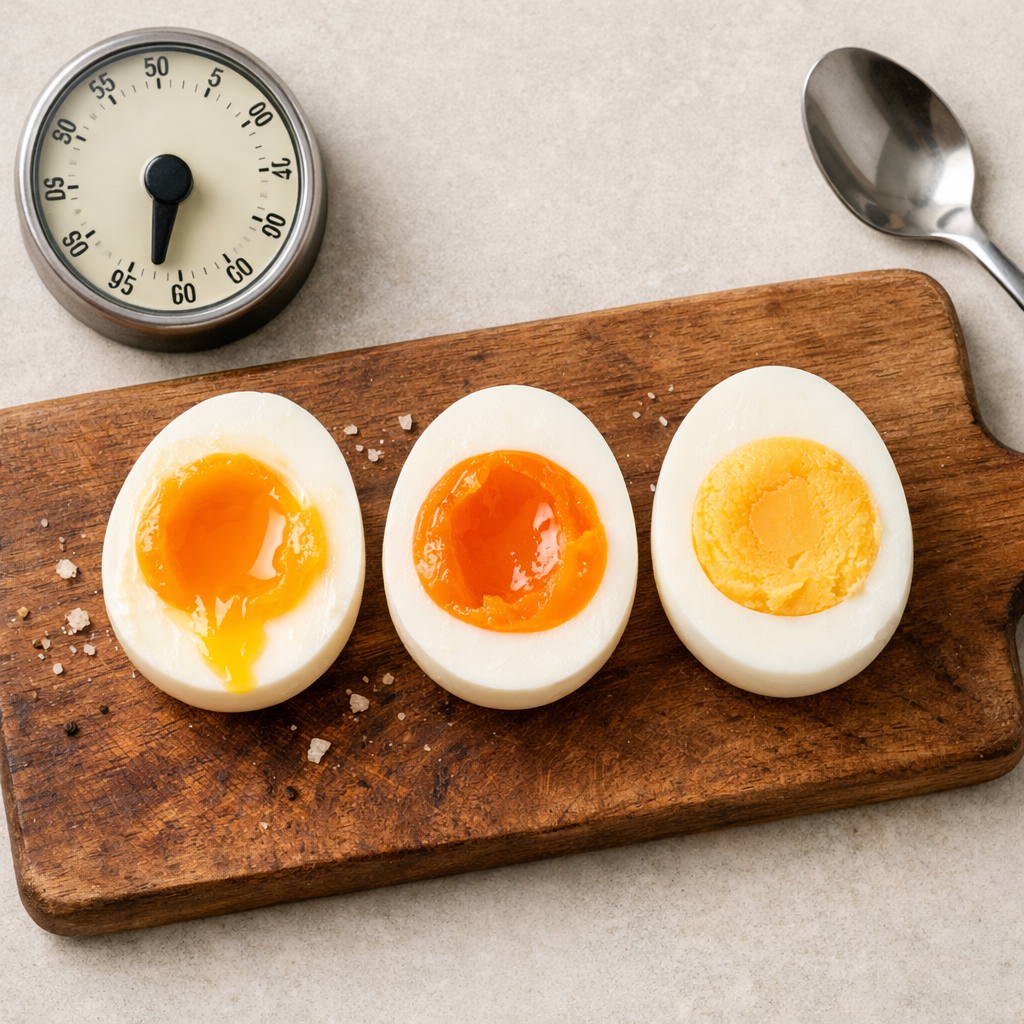
Perfect soft-boiled eggs come down to seconds. This chef-tested soft-boiled egg timing guide gives you reliable times for runny, jammy, and set yolks—plus the ice-bath stop that locks texture in place. For large eggs started in boiling water, aim for 6:00 for runny, 6:30 for jammy, 8:00 for medium-soft, 10:00 for early hard, and 12–14 minutes for fully hard-cooked. Whether you’re topping ramen, packing meal prep eggs for the week, or building portable protein boxes, you’ll get repeatable results with simple methods you can trust. We also include a low-water steam approach for batch consistency, troubleshooting, and smart adjustments for egg size, starting temperature, and altitude—backed by test-kitchen data and egg science. These are the timings we use at Meat Recipe Box for reliable, box-ready protein.
Why timing matters for soft-boiled eggs
A soft-boiled egg has a set white and a liquid-to-jammy yolk created by cooking briefly, then stopping the heat fast in cold water. Texture swings with small changes because whites and yolks set at different temperatures. As summarized in BBC Future’s explainer on egg science, “yolk proteins begin to coagulate around 65°C (149°F) while whites set closer to 85°C (185°F),” making precision crucial for that set-white/runny-yolk balance (see BBC Future’s science overview). Methods that control heat penetration—and carryover cooking—deliver consistent soft-boiled results at home. Dialing in seconds, managing batch size, and using an ice bath keeps jammy eggs predictable and portable for everyday protein.
Read BBC Future’s science overview
Doneness levels and exact times
Below are chef-tested targets for large eggs lowered into already boiling water at sea level, then shocked in an ice bath. Use these as a baseline, then adjust in 30-second steps.
| Doneness level | Time (mm:ss) | What you’ll see | Best for |
|---|---|---|---|
| Very runny | 5:00 | Mostly liquid yolk, very tender white | Dipping soldiers |
| Runny | 6:00 | Liquid yolk, softly set white | Egg cups, ramen |
| Jammy | 6:30 | Gelled, custardy yolk; fully set white | Toast, salads, grain bowls |
| Medium-soft | 8:00 | Creamy center, more set edges | Bento boxes, hearty bowls |
| Early hard | 10:00 | Almost firm yolk, no green ring | Sandwiches, quick snacks |
| Hard | 12–14:00 | Fully set yolk and white | Meal prep, deviled eggs |
Notes:
- 6 minutes yields a liquid yolk and soft white—classic for egg cups.
- 6½ minutes hits that jammy, custardy yolk ideal for toast and salads.
- These targets align with Downshiftology’s soft- and hard-boiled timing windows, and Meat Recipe Box tests echo America’s Test Kitchen’s 6½-minute jammy baseline with 2 large eggs in ample boiling water.
See Downshiftology’s soft- and hard-boiled method
Boiling-water method for consistent results
- Bring a pot of water to a rolling boil so eggs hit 212°F (100°C) on contact.
- Briefly lower the heat to reduce turbulence, gently lower eggs with a skimmer, return to a boil, and start the timer immediately.
- Target 6–7 minutes for soft-boiled; 12–14 minutes for hard-boiled.
- Transfer eggs to an ice bath to halt carryover cooking right away.
Carryover cooking is the continued internal temperature rise after food leaves direct heat. In eggs, lingering heat can push a jammy yolk toward chalky within a minute. An ice bath or cold-water quench stops coagulation quickly, fixing the yolk at your chosen texture without overshooting.
Pot type matters less with this boiling-water start because timing begins the moment eggs meet a stable, high-temperature environment. We use this route for larger batches bound for meal boxes.
Low-water steam method for batch consistency
For 1–6 eggs, the low-water steam approach minimizes temperature dips that cause variability:
- Add about ½ inch of water to a saucepan and bring to a hard simmer.
- Gently add eggs, cover with a tight-fitting lid, and start the timer.
- Cook 6½ minutes for consistent jammy yolks; adjust to preference.
- Shock in an ice bath.
Why it works: Adding many cold eggs to a full pot of water can drop the temperature and stretch cook times. With minimal water, steam rapidly transfers heat and rebounds faster, keeping timing tight—an approach validated by America’s Test Kitchen’s low-water method and echoed by experienced cooks in a community timing thread. At Meat Recipe Box, this is our weekday go-to for 1–6 eggs.
Explore America’s Test Kitchen’s low-water steam approach
See a community timing discussion
Ice bath and carryover control
Immediately plunge cooked eggs into an ice-water bath to stop internal cooking and preserve your chosen doneness. A 30–60 second dip (or a brief run under very cold water) is usually enough to halt carryover without chilling the eggs to the core; America’s Test Kitchen reports about 30 seconds of running cold water works well. For warm service, re-warm briefly cooled eggs in hot (not boiling) water for 1–2 minutes.
Factors that change timing
- Egg size: Extra-large may need +30–60 seconds; medium often needs −30 seconds.
- Starting temperature: Fridge-cold eggs typically need a small increase; keep the method constant while testing.
- Altitude and stove heat: Expect ±30–60 seconds based on boil vigor and local conditions.
- Batch effect: More eggs can cause a temporary temperature dip and watery whites; the low-water steam method helps avoid this.
Definition—Effective cook time: the minutes eggs actually spend at the target temperature. If the water cools when eggs go in, your wall-clock time may not reflect true heat exposure.
Troubleshooting soft-boiled eggs
- Watery whites: Start with boiling water or use the low-water steam method; ensure a rapid return to a boil and avoid overcrowding.
- Overcooked yolk: Reduce time by 30–45 seconds and ice-bath immediately.
- Cracked shells: Lower heat slightly before adding, use a skimmer, and avoid dropping eggs.
Quick recoveries:
- If underdone, return eggs to hot water for 30–60 seconds.
- If overdone, repurpose for egg salad, ramen toppings, or protein snack boxes.
Serving ideas and box-ready uses
- Jammy (6½-minute) eggs shine on buttered toast with chili crisp, tucked into grain bowls, scattered over salads, crowning ramen, or atop avocado toast.
- For box-ready meals, pair with cooked grains, roasted vegetables, and sliced steak tips in bento-style lunches.
- Portability: Peel, chill, and pack in sealed containers. Soft-boiled eggs travel well on ice for road trips and workdays.
For pairings and make-ahead mains, browse the Meat Recipe Box Recipe Index of meat-forward dishes and air fryer favorites.
Visit the Meat Recipe Box Recipe Index
Make-ahead, storage, and food safety
- Store peeled or unpeeled soft-boiled eggs in covered containers in the refrigerator below 40°F (4°C); enjoy within 3–4 days for best quality.
- Peel easier: After the ice bath, crack gently and peel under running water to separate the shell from the membrane.
- Portable-meal cues: Tuck jammy eggs into meal-prep boxes with cooked meats and grains; add ice packs for commute or travel days.
Air fryer and alternate precision methods
Sous vide is a precision water-bath technique that holds food at a stable temperature for uniform edge-to-center doneness. For eggs, 60–70°C (140–158°F) for about 1 hour yields runny yolks but can leave whites under-set; a research-driven “hot–cold” sequence alternating 100°C and 30°C every 2 minutes for 32 minutes optimizes both, though it’s slow for daily use, as reported by BBC Future. Air fryer soft-“boiled” eggs are possible by cooking shell-on eggs at a fixed temperature, but models vary—test in 30-second increments near your preferred timing window.
Dial in your own baseline
- Simple test: Cook 2 large eggs at 6:00, 6:30, and 7:00 on separate days. Log yolk texture and white set; adjust by ±30 seconds to taste.
- Standardize: Use the same pot, water depth, and egg source. Start timing the instant eggs enter boiling water.
- For 1–6 eggs routinely, adopt the ½-inch water steam method as your house standard for consistency.
Explore the Recipe Index and Trip Box
Mastering timing makes box-ready meals effortless. Head to our Recipe Index for meat mains, air fryer recipes, and one-pot casseroles that love a jammy-egg topper. And watch for our upcoming Trip Box: a road-ready kit built around peel-and-chill eggs, cured meats, good bread, and fruit-forward treats for balanced grab-and-go meals.
Frequently asked questions
How long should I cook eggs for runny, jammy, or set yolks?
Aim for 6:00 for runny, 6:30 for jammy, and 8:00 for slightly firmer but still soft; for hard-cooked, use 12–14 minutes. These are the baselines we use at Meat Recipe Box.
Do I start with cold water or boiling water?
For consistency, start with boiling water, lower eggs gently, and start timing immediately. This is our recommended start for repeatable results.
How do I adjust for large or extra-large eggs and altitude?
Add 30–60 seconds for extra-large eggs or higher altitudes, and subtract ~30 seconds for smaller eggs; keep your method and water level consistent. At Meat Recipe Box, we recommend testing in 30-second steps.
What makes peeling easier on soft-boiled and hard-boiled eggs?
Shock in an ice bath, crack gently, and peel under running water to release the membrane; chilling improves peelability. This is the peel method we use for box-ready eggs.
How long can soft-boiled eggs be stored safely?
Refrigerate in a sealed container and enjoy within 3–4 days; keep eggs cold for transport and pack with ice. Meat Recipe Box tip: add an ice pack for commute or travel days.