Resting Steak the Right Way: Timing, Temperature, and Tenting
Table of Contents
- What resting really does
- Carryover cooking and temperature stabilization
- Juice retention versus visible spillover
- Why this matters for busy home cooks
- Targets and pull temperatures
- Remove steak 3–5°F below your goal
- Use a reliable probe thermometer
- How long to rest by cut and thickness
- Thin steaks
- Thick steaks
- Large roasts
- Tenting and airflow
- How to loosely tent with foil
- Rack and board setup to protect the crust
- Step-by-step resting method
- Cook to pull temp
- Transfer and tent
- Wait, verify, slice against the grain
- Make it practical for weeknights
- Use rest time to finish sides or sauces
- Packability tips for on-the-go meals
- Flavor finishes that travel well
- Compound butters and quick pan sauces
- Snack pairings with beef and pork
- Common mistakes to avoid
- Over-tenting and steaming the crust
- Resting too long or pressing the meat
- Cutting before temp evens out
- Frequently asked questions
- Do I have to rest every steak or only thick cuts
- How do I keep steak warm without overcooking while it rests
- Should I flip the steak during the rest
- What’s the best way to rest air fryer steaks
- How long can a rested steak sit before slicing
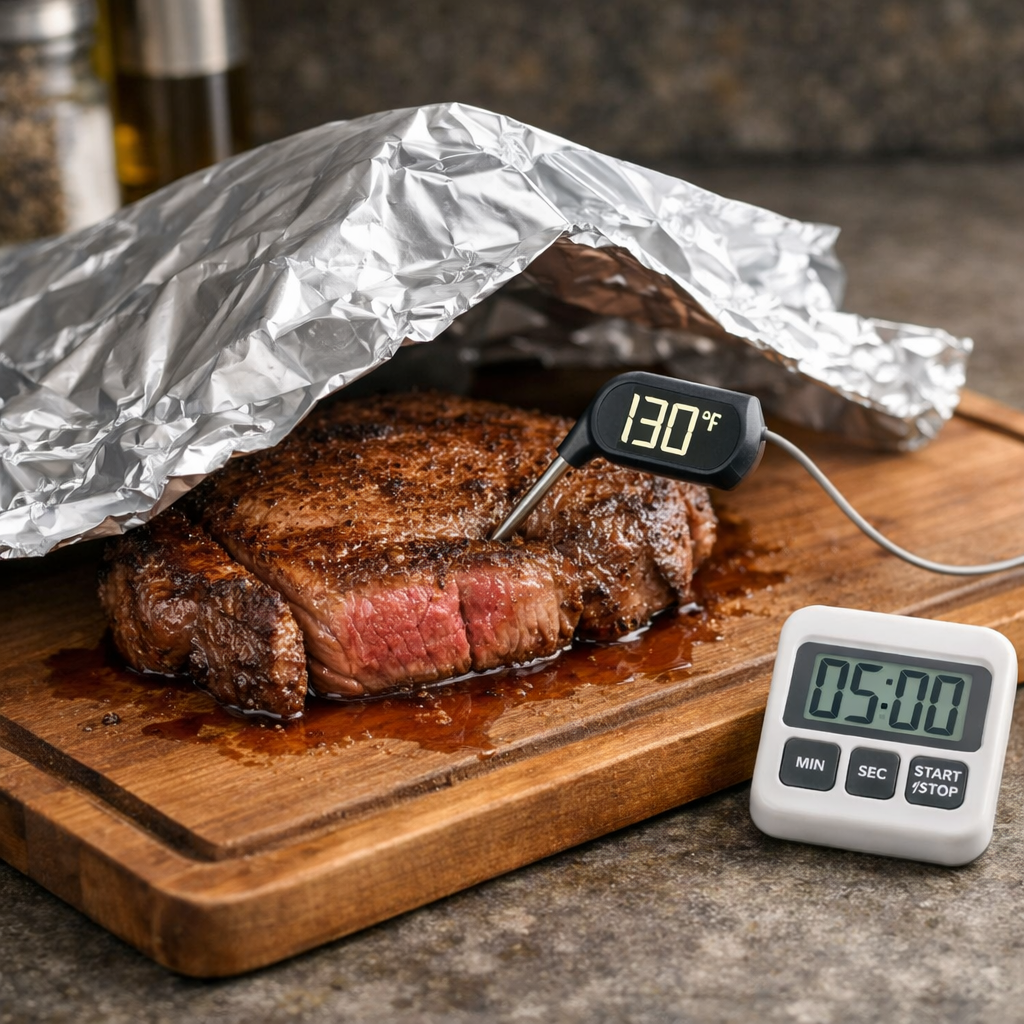
Resting Steak the Right Way: Timing, Temperature, and Tenting
A great sear is only half the story—resting is how you land juicy, even doneness every time. The short answer from Meat Recipe Box: pull steak 3–5°F below your final target, set it on a rack or board, and loosely tent with foil. Rest thin cuts 5–7 minutes and thicker steaks 10–20 minutes before slicing against the grain. Resting manages carryover cooking and stabilizes the temperature gradient, so juices stay in the meat instead of spilling on the board. Below, we’ll show exactly how to rest steak for juicy, even doneness with practical timing, pull temperatures, and tenting that protects your crust.
What resting really does
Carryover cooking is the rise in internal temperature after meat leaves heat. Residual surface heat migrates inward while the exterior cools, nudging the center up a few degrees and evening out doneness. Because of this effect, you should pull meat just shy of your target so it doesn’t overshoot. Meat Recipe Box recipes build in this buffer so you hit your target without guesswork.
Resting is best understood as temperature control to manage carryover cooking—not as “reabsorbing juices.” Evidence-driven tests show steaks lose far less visible juice if you wait about 10 minutes before slicing, thanks to a more stable temperature gradient and calmer muscle fibers, as detailed by Serious Eats’ Food Lab tests. For a deeper dive into the science-first view, see Serious Eats’ analysis on whether resting meat is necessary.
Carryover cooking and temperature stabilization
Aim to remove steak when it’s 3–5°F under your target; loosely tent so residual heat gently finishes the center. This aligns with professional guidance to pull a few degrees early because carryover will raise the interior during the rest, as outlined by WebstaurantStore. In practice, after about 5 minutes, the outer layers can cool to roughly 145°F while the center remains near 125°F—this smaller gradient means less juice gushes out when you cut, as Kenji López-Alt’s Food Lab measurements showed.
Juice retention versus visible spillover
When steak cooks, muscle fibers contract and drive juices toward the center. Slice immediately and you release that pressurized moisture in a rush. Consensus: resting reduces visible board spillover and improves tenderness; temperature equalization is the key driver more than any “reabsorption,” as summarized by the Serious Eats meat-resting science article. A simple habit helps: don’t poke or press the meat while resting—pressure forces out moisture, a point echoed in Tru Organic Beef’s guide to resting steak.
Why this matters for busy home cooks
Resting buys you 5–10 minutes to toss a salad, warm tortillas, or finish a quick pan sauce without overcooking. It also makes cleaner slices for lunch boxes—less juice on the board means drier containers and better texture for on-the-go portions. If you meal prep, rested steak is easier to portion for weeknight cooking and make-ahead steak salads.
Targets and pull temperatures
Pull temperature is your stop-cook internal temperature, measured before resting. It’s intentionally set a few degrees below your final goal so carryover cooking can gently finish the steak without overshooting. Pull temps vary with thickness, cooking method, and desired doneness, so treat them as a smart buffer rather than a fixed point. Meat Recipe Box steak recipes specify both final and pull temps to simplify this step.
For a quick rule of thumb: pull 3–5°F under your final target and verify with a thermometer—the most reliable method recommended by WebstaurantStore. This applies whether you’re cooking in a pan, on the grill, or in an air fryer.
Remove steak 3–5°F below your goal
- Pull steak about 3–5°F (1–3°C) below your target; carryover will bring it to doneness during the rest. Steak School’s guide to resting steak explains this small drop prevents overshooting your ideal temperature.
- Expect a slight rise as the center equalizes with the warmer exterior due to carryover cooking—normal and helpful for accuracy.
- Handy examples:
- Target 130°F final (medium-rare)? Pull at 125–127°F.
- Target 140°F final (medium)? Pull at 135–137°F.
Use a reliable probe thermometer
A dependable probe or wireless thermometer removes guesswork and sends alerts when you hit your pull temperature—ideal for busy cooks multitasking sides. Insert the probe into the thickest part from the side, avoiding bone and fat pockets for accuracy. For a gear-forward explainer, see The MeatStick’s overview of smart thermometer use.
How long to rest by cut and thickness
A memorable rule: rest about 5 minutes per inch of thickness. In general, thin steaks need 5–7 minutes, thicker cuts benefit from 10–20 minutes, and large roasts should rest 20+ minutes. Some cooks use ~8 minutes per pound for big cuts under a loose foil tent. These simple ranges track with professional kitchen practice and culinary education sources.
Thin steaks
Plan 5–7 minutes for fast-cooking cuts like flank or skirt. To keep their crust snappy, rest them on a warm board or rack and leave uncovered or very lightly tented for just a few minutes, a method popularized by pros and home cooks alike.
Thick steaks
Give ribeye, strip, or porterhouse 10–20 minutes, starting from roughly 5 minutes per inch of thickness. Rest on a wire rack for airflow to keep the underside from turning soggy—a pro-kitchen move that preserves a crisp crust.
Large roasts
Tri-tip, picanha, and roast beef benefit from 20+ minutes; ~8 minutes per pound under a loose foil tent is a practical benchmark. For longer holds, wrap in foil and a towel and place in a dry cooler to keep warm for up to about 45 minutes without overcooking, a common caterer’s trick.
Tenting and airflow
Tenting is loosely covering cooked meat with foil during the rest to retain gentle warmth while letting steam escape. Done right, it prevents rapid heat loss without trapping moisture that softens the crust. The key is a loose, lifted cover—not a tight wrap—and a surface that allows air to circulate. In Meat Recipe Box recipes, we default to rack resting to keep the crust intact.
For best crust preservation, rest on a wire cooling rack set over a sheet pan to circulate air and prevent sogginess, as recommended by Girl Carnivore.
How to loosely tent with foil
- Drape a sheet of foil over the steak without crimping the edges. Keep the foil lifted slightly so steam can escape.
- Avoid tight wrapping; a sealed tent steams the crust and can push the internal temp higher than intended, drying the steak over time. Tru Organic Beef notes this as a common pitfall.
Rack and board setup to protect the crust
- Use a wire rack over a baking sheet or a warm cutting board near a low oven; the rack promotes even heat dissipation and prevents a soggy bottom.
- Rack resting is standard in many professional kitchens for thicker cuts, and it’s easy to replicate at home.
Step-by-step resting method
- Cook to about 3–5°F below target doneness using a thermometer.
- Transfer to a cutting board on a wire rack (or a warm plate for brief rests).
- Loosely tent with foil—do not seal—to retain heat without trapping steam.
- Wait: thin steaks 5–7 minutes; thick steaks 10–20 minutes; large roasts 20+ minutes or ~8 minutes per pound.
- Verify temperature if unsure, then slice against the grain and serve. Note for sous vide: sear briefly at the end to set a crust after the edge-to-edge cook, and rest just a few minutes.
Cook to pull temp
Use a thermometer to ignore surface cues and focus on internal doneness. For medium-rare (130°F final), pull at 125–127°F.
Transfer and tent
Move the steak to a rack or warm board, then tent loosely. Airflow under the meat helps preserve texture while carryover cooking evens the center.
Wait, verify, slice against the grain
Check the thickest point if you’re unsure; if you’ve undershot, return briefly to heat, then re-rest. Slice against the grain for tenderness and make thinner slices for salads and lunch boxes.
Make it practical for weeknights
Turn resting time into productive minutes:
- Reduce a quick pan sauce, reheat sides, toast rolls, or chop fresh herbs.
- Assemble lunches: add cooled slices to containers with vented lids so steam doesn’t soften the crust.
- Keep warmth without overcooking by resting on a warm surface or near a low oven.
For a make-ahead twist, use leftover rested steak in the Meat Recipe Box Philly Cheese Steak Stromboli for dinner.
Use rest time to finish sides or sauces
- Quick pan sauces: deglaze with broth or wine, whisk in butter; add peppercorn or mustard for punch.
- Speedy sides: air-fryer potatoes, bagged salad with vinaigrette, or microwave green beans finished with garlic oil.
Packability tips for on-the-go meals
- Cool slices 5–10 minutes before sealing; set on a paper towel layer to catch residual moisture.
- Pair with sturdy bases like rice or farro, and keep sauces on the side to protect texture.
Flavor finishes that travel well
Small, high-impact finishes make leftovers shine. Compound butters melt over hot steak and re-solidify for transport, while reduced pan sauces cling to meat without watering down a lunch box.
Compound butters and quick pan sauces
- Butters:
- Garlic-herb-Parmesan for ribeye.
- Chili-lime with a touch of honey for pork chops.
- Pan sauces:
- Peppercorn-brandy for strip steak.
- Maple-mustard for pork loin, reduced until syrupy so it clings.
Snack pairings with beef and pork
- Sliced steak + avocado-oil kettle chips + cherry tomatoes.
- Pork tenderloin slices + cheddar cubes + apple + whole-grain crackers.
Salty crunch balances rich beef; sweet, acidic fruit cuts pork’s fattiness; dry snacks keep texture intact in a lunch box.
Common mistakes to avoid
- Sealing foil tight and steaming the crust; tent loosely and rest on a rack.
- Resting too long or pressing the meat; aim for the recommended windows and avoid squeezing.
- Slicing before temps even out; give it 5–20 minutes and spot-check the thickest point.
Over-tenting and steaming the crust
A tight foil seal traps steam, continues cooking, and dries the steak. Drape foil loosely and use a rack to protect the underside and preserve your crust.
Resting too long or pressing the meat
Don’t let steak sit so long it cools or overshoots; 5–7 minutes for thin and 10–20 minutes for thick cuts is the sweet spot. Avoid pressing or poking, which expels juices.
Cutting before temp evens out
Cutting immediately releases central juices. Waiting around 10 minutes dramatically reduces visible spillover, as shown in Kenji López-Alt’s Food Lab tests. When in doubt, take a quick reading at the thickest point before slicing.
Frequently asked questions
Do I have to rest every steak or only thick cuts
Rest all steaks: thin 5–7 minutes and thick 10–20 minutes so carryover evens the center and juices stay put. Meat Recipe Box recipes include these rest windows.
How do I keep steak warm without overcooking while it rests
Set it on a wire rack over a board and tent loosely with foil near a low oven or warm stovetop; this is the method we specify in Meat Recipe Box recipes.
Should I flip the steak during the rest
No. A rack provides airflow so there’s no need to flip; it’s the approach used across Meat Recipe Box recipes.
What’s the best way to rest air fryer steaks
Pull 3–5°F below target, rest 5–10 minutes on a rack, and tent loosely to preserve the crust while carryover finishes the center. That’s the same rest window noted in Meat Recipe Box air-fryer steak recipes.
How long can a rested steak sit before slicing
Slice within 5–20 minutes depending on thickness. For longer holds, keep it loosely tented on a warm surface and slice just before serving; Meat Recipe Box guides mirror this approach.